
BidProse webinar series
Practical GovCon Learning You Can Use on the Next Pursuit.
BidProse webinars focus on the real challenges government contractors face across strategy, capture, proposals, reviews, and organizational capability.
Each session is designed to give participants practical guidance they can take back to their teams and apply immediately.
Get Notified When Webinars Launch
2026 Webinar Calendar
APril
APril
APril
BUILD:
How to Build a Proposal Library That Actually Gets Used
May
APril
APril
GROW:
Why Good Proposals Still Lose: Turning Evaluation Criteria into Scoreable Content
June
APril
June
IMPROVE:
Beyond Editing: How to Build a Proposal Quality Control Process That Catches Issues Early
July
October
June
PURSUE:
Before You Write: How to Structure a Technical Approach Evaluators Can Follow
August
October
October
PURSUE:
Beyond Experience: How to Write Past Performance That Supports Scoring
October
October
October
CAPTURE:
Before the RFP: How Strong Capture Creates Stronger Proposals
November
November
November
BUILD:
From Reactive to Repeatable: Building a GovCon Operating System That Scales
December
November
November
IMPROVE:
Where GovCon Teams Lose Momentum: The Capability Gaps That Create Rework, Risk, and Missed Opportunities
Upcoming Webinars
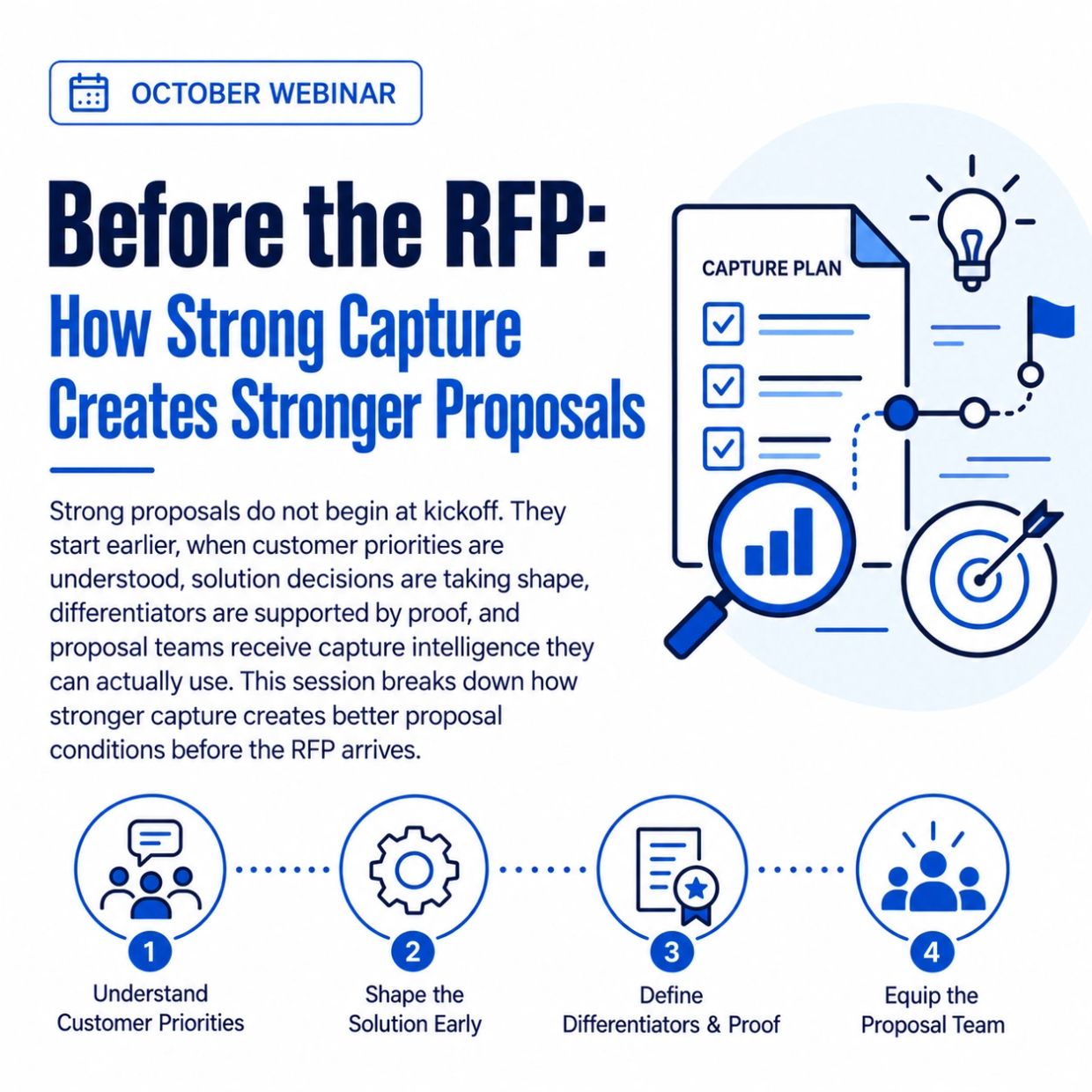
Before the RFP: How Strong Capture Creates Stronger Proposals
Many proposal teams treat capture as background research they hand off when the RFP arrives. That is not enough. Strong capture should give the proposal team a clear understanding of customer priorities, competitive positioning, solution direction, differentiators, proof, and unresolved risks before drafting begins. This session will break down how to turn capture activity into usable proposal intelligence so the team starts with stronger positioning, clearer direction, and fewer strategic decisions left unresolved after kickoff.
Key Takeaways:
- How to identify customer priorities before the RFP is released
- How to shape the solution before proposal drafting begins
- How to translate capture intelligence into proposal strategy
- How to define meaningful differentiators and support them with proof
- How to identify and address gaps and risks early
- How to build a stronger capture-to-proposal handoff
- How to give proposal teams usable direction instead of a folder of background information
- How strong capture creates better starting conditions for a clearer, more compelling proposal
Wednesday, October 28, 2026 @ 1PM EST
Live + On-Demand
How to Build a Proposal Library That Actually Gets Used
WHY GOOD PROPOSALS STILL LOSE: TURNING EVALUATION CRITERIA INTO SCOREABLE CONTENT
WHY GOOD PROPOSALS STILL LOSE: TURNING EVALUATION CRITERIA INTO SCOREABLE CONTENT
Most teams already have content, but it keeps getting rewritten because there’s no structure behind it.
This session breaks down how to build a proposal library that supports how proposals are actually developed and evaluated.
Key Takeaways:
- What content actually belongs in a proposal library and what doesn’t
- How to structure content so it can be reused without rewriting
- How a structured library improves speed, consistency, and compliance
WHY GOOD PROPOSALS STILL LOSE: TURNING EVALUATION CRITERIA INTO SCOREABLE CONTENT
WHY GOOD PROPOSALS STILL LOSE: TURNING EVALUATION CRITERIA INTO SCOREABLE CONTENT
WHY GOOD PROPOSALS STILL LOSE: TURNING EVALUATION CRITERIA INTO SCOREABLE CONTENT
Most teams already have strong proposal content, but it still loses points when evaluators cannot clearly find, validate, and justify the strengths.
This session breaks down how proposals are actually evaluated and how to turn good content into scoreable content that aligns with the criteria, supports clear findings, and makes it easier for evaluators to assign higher ratings.
Key Takeaways:
- What evaluators are actually looking for when they assign scores
- Why strong writing alone does not translate into higher ratings
- How to structure responses so they are easy to find, validate, and justify
- How to turn proposal content into clear, defensible strengths
- What to change so your proposals are built to score, not just read well
before you start writing: how to read a goverment solicitation
WHY GOOD PROPOSALS STILL LOSE: TURNING EVALUATION CRITERIA INTO SCOREABLE CONTENT
Beyond Editing: How to Build a Proposal Quality Control Process That Catches Issues Early
Many small businesses want to pursue government contracts, but the solicitation itself can be one of the biggest barriers. The requirements are often spread across multiple sections, attachments, clauses, instructions, and evaluation criteria, making it difficult to know where to start.
This session breaks down how to read a government solicitation with purpose, so businesses can identify what the Government is asking for, what must be submitted, how the response will be evaluated, and where compliance risks may appear before proposal writing begins.
Key Takeaways:
- How to identify the most important sections of a government solicitation
- What to look for in the instructions, evaluation criteria, and scope of work
- How to recognize submission requirements and compliance risks early
- How to turn solicitation requirements into a clear proposal plan
- Why reading the solicitation correctly is the foundation for a compliant and competitive response
Beyond Editing: How to Build a Proposal Quality Control Process That Catches Issues Early
Beyond Editing: How to Build a Proposal Quality Control Process That Catches Issues Early
Beyond Editing: How to Build a Proposal Quality Control Process That Catches Issues Early
Most teams find proposal issues too late, when the content is already written, deadlines are tight, and fixes create more pressure on the team.
This session breaks down how to build a proposal quality control process that catches issues early, strengthens compliance, improves evaluator alignment, and prevents final review from becoming a rescue mission.
Key Takeaways:
- Why final review is not the same as quality control
- Where proposal quality breaks down during the process
- How to define quality before writing starts
- How to build compliance, clarity, proof, and consistency into each stage
- How to use structured reviews to catch issues before submission
Before You Write: How to Structure a Technical Approach Evaluators Can Follow
Beyond Editing: How to Build a Proposal Quality Control Process That Catches Issues Early
Before You Write: How to Structure a Technical Approach Evaluators Can Follow
Most proposal teams start writing the technical approach too soon.
Before drafting begins, the team needs a clear structure that follows the requirements, aligns with the evaluation criteria, and makes the response easy for evaluators to follow.
This session will break down how to organize a technical approach before writing so the proposal is easier to draft, easier to review, and easier to evaluate.
Key Takeaways:
- Why structure should come before writing
- How to map requirements before drafting begins
- How to build a technical approach outline
- How to align the response to evaluation criteria
- How to reduce rewrites, review confusion, and evaluator burden
- How to make the technical approach clearer, more compliant, and easier to score
BEYOND EXPERIENCE: HOW TO WRITE PAST PERFORMANCE THAT SUPPORTS SCORING
Beyond Editing: How to Build a Proposal Quality Control Process That Catches Issues Early
Before You Write: How to Structure a Technical Approach Evaluators Can Follow
Many past performance sections read like experience summaries. That is not enough. Evaluators need to understand why the example matters, how closely it aligns with the current requirement, what the team delivered, and what results show successful performance. This session will break down how to write past performance content that goes beyond describing what happened and instead gives evaluators the evidence they need to assess relevance, confidence, and risk.
Key Takeaways:
- How to select the strongest past performance examples
- How to show relevance and similarity to the current requirement
- How to connect scope, complexity, and contract characteristics
- How to highlight measurable results and proof
- How to avoid generic experience summaries that do not support scoring
- How to write past performance with evaluator confidence in mind
- How to make the connection between prior performance and future execution clear
Copyright © 2025 BidProse Strategy Group LLC -
All Rights Reserved.
BidProse Strategy Group LLC | 407-603-6102 |
This website uses cookies.
We use cookies to analyze website traffic and optimize your website experience. By accepting our use of cookies, your data will be aggregated with all other user data.